
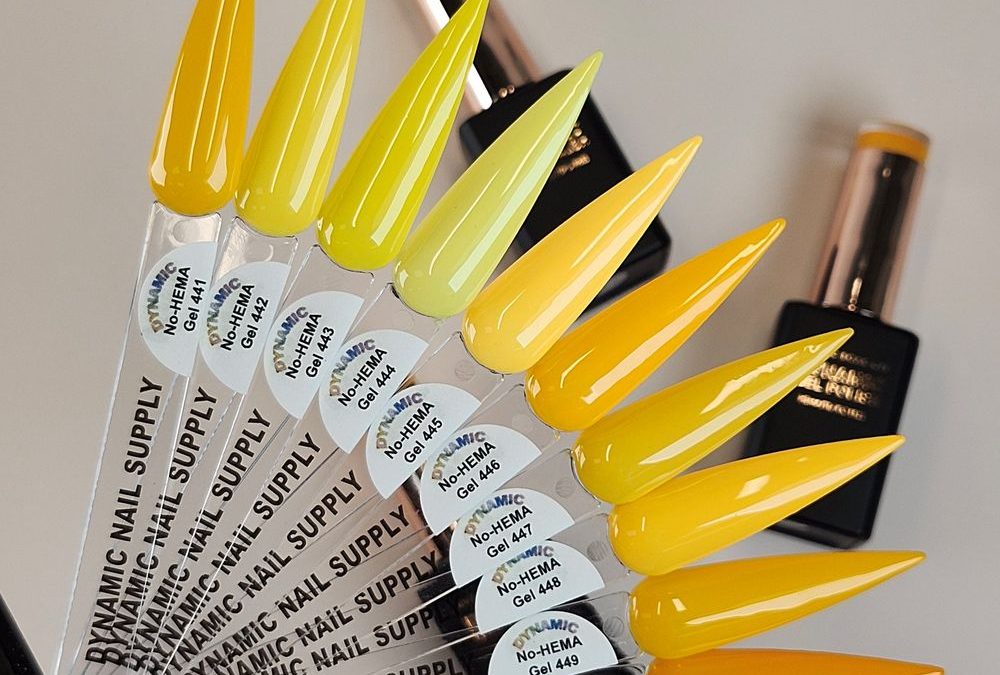
Dynamic No-HEMA Gel Polish – Color 441 to 450 is a ten-shade yellow-based fall palette in high-gloss cream finishes built for bold gradients and clean salon results.
How this mustard to lemon ombré reads and who will want it
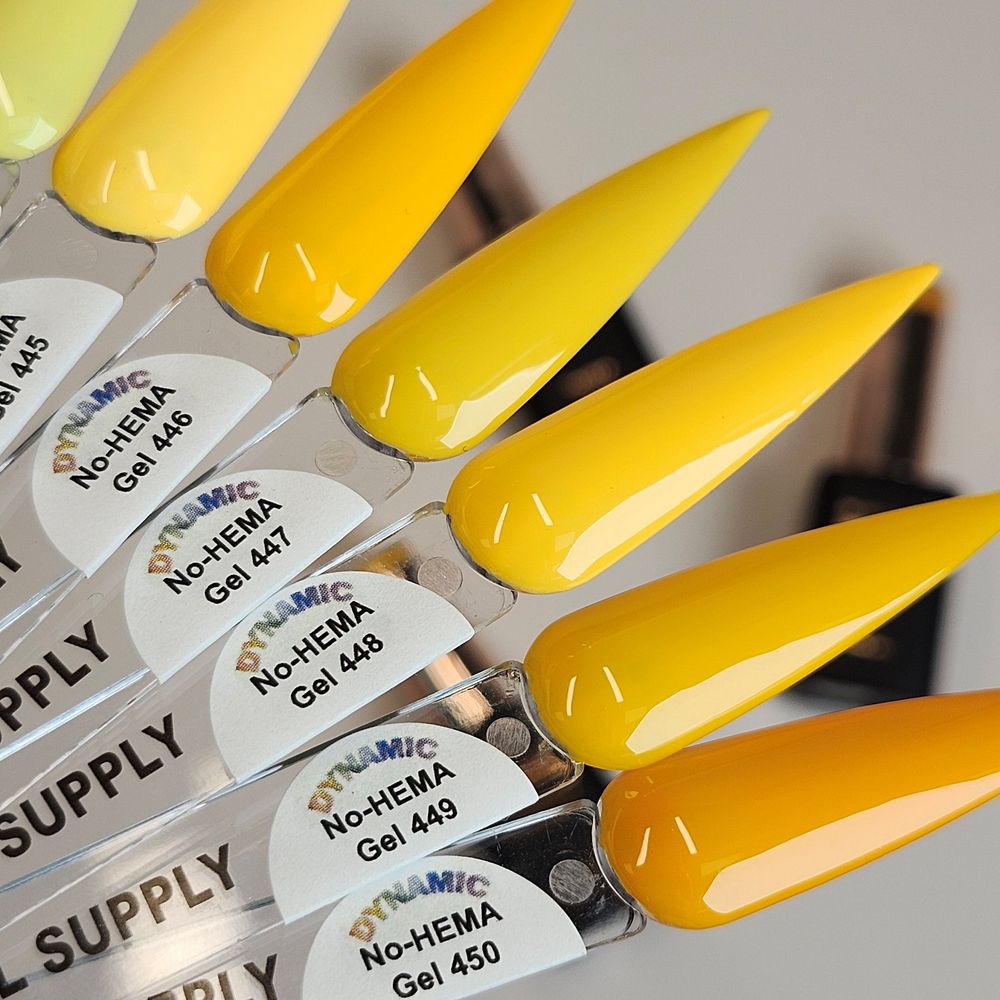
This particular set moves from deep mustard through warm golds and neon lemon to amber orange. The range is all opaque creme finishes with no shimmer, so the transition reads bright and clean. You should offer this ombré when a client wants a high-impact warm look that still photographs flat and glossy. It fits both natural nails and extension work where opaque creams look most even.
Plan the color roles: assign each gel in the blend
Define three visual roles before you touch a brush: anchor, midtone, and pop. For mustard to lemon ombré set the roles like this:
- Anchor — choose the deeper mustard or amber for the nail root and shadow (No-HEMA Gel 441 or 442).
- Midtone — pick a warm golden-yellow to carry the transition (examples: 444, 446).
- Pop — use the neon lemon or bright canary for the tip or highlight (No-HEMA Gel 448 or 449).
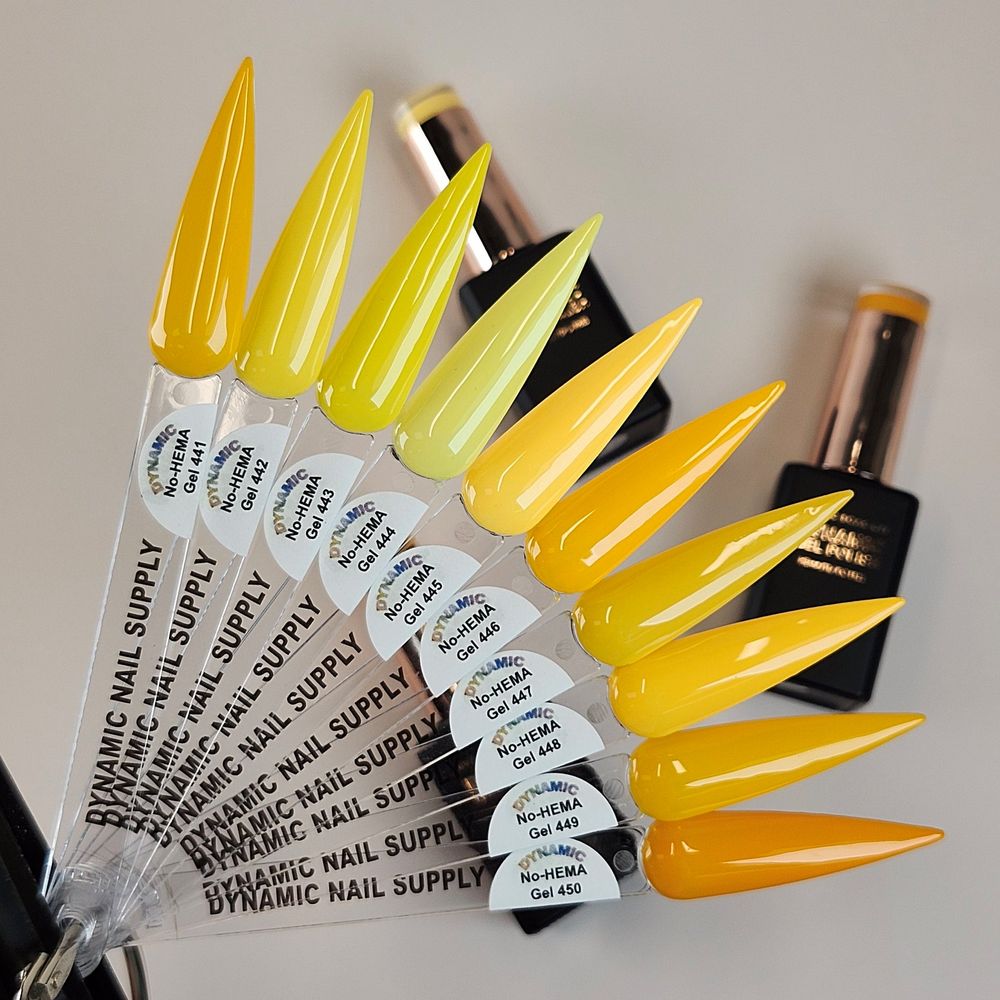
Assign specific numbers on your service card so the assistant can prep bottles and swatch sticks in order. Label the roles in the sequence that will appear on the nail from cuticle to free edge.
Station, tools, and brush selection for clean gradients
Keep a simple station layout: lamp, lint-free wipes, isopropyl wipe, palette or glass tile, thin gel brush, fan brush or small flat blender, and a thin liner for cleanup. Choose these brushes:
- Thin gel brush — for placing base color and thin passes near the cuticle.
- Flat blending brush or short fan — to soften the edge where two colors meet without reworking cured layers.
- Liner — for defining a sharp smile line or cleaning sidewalls.
Keep bottles upright and stir gently before use. Because these are high-pigment creams, work in thin layers to avoid pooling at the cuticle.
Prepped base: natural nail and primer workflow
- File to the chosen shape and remove dust with a brush.
- Dehydrate the nail surface lightly and apply a bonded base layer in a thin coat. Do not over-etch the plate; these gels perform with minimal prep.
- Cure base according to lamp recommendation for 60–120 seconds depending on output.
Step-by-step mustard to lemon ombré salon application
- First thin anchor pass: Load a thin gel brush with the anchor color (deeper mustard). Paint the proximal third of the nail in a thin coat. Cure briefly — tack-cure 10–15 seconds if your lamp allows partial cure, or full cure if you prefer distinct layers.
- Place midtone: Wipe the brush and pick up the midtone. Lay it over the center third and slightly overlap the anchor by 1–2 mm. If you tack-cured the anchor, the overlap will blend when you feather it.
- Tip pop: Apply the neon lemon to the free edge. Keep this tip coat thin to avoid doming; neon pigments hide irregularities when thinly layered.
- Feather blend: Before final cure, use a short flat blender or a clean thin brush damp with a tiny amount of tack-layer-friendly solution to drag the join zones gently inward. Work from the midtone edges toward the center to avoid streaks.
- Layer control: Cure for 60–120 seconds after you’re satisfied with the wet blend. If opacity needs increase, repeat thin passes rather than one heavy coat. Two thin layers give a smoother gradient than one thick layer.
- Final finish: After the last cure, seal with a high-gloss topcoat and cure to lock the blend and enhance depth.
Keep each pass thin; heavy pigment in cream gels can show brush strokes if not leveled with thin layering and controlled blending.
Thinning and viscosity tips for smooth, streak-free blends
If the gels sit too thick on your brush, place a pea-size amount on a glass tile and thin with a manufacturer-recommended gel thinner or a warmed tile technique (gently warm the tile, not the gel). Do not add monomers or solvents. Work quickly when thinning neon shades—high-pigment formulas can skin over in open air more quickly.
Spotlight: No-HEMA Gel 441
No-HEMA Gel 441 is the deepest mustard in this 441–450 Fall Vibes Collection. Use 441 as the visual anchor at the cuticle and lower half of the nail when you want a retro or earthy starting point for the ombré. Its opacity and warm undertone make it ideal for anchoring the gradient without muddying adjacent warm yellows. On shorter natural nails, 441 reads like a strong base that balances the neon lemon tip.
Best for
- Clients who request bold, warm-toned gradients with high gloss.
- Salon services where quick thin layering and strong pigmentation are required.
- Sunflower or botanical-inspired sets that use a unified yellow palette.
Not ideal for
- Clients who want subtle pastel fades—this palette skews high-pigment and vivid.
- Services that require matte finish looks unless a separate matte topcoat is used.
- Technicians who prefer low-pigment sheer gels for natural translucency.
Finishing, curing workflow and cleanup
Cure fully after each build step according to your lamp output (the range cures in 60–120 seconds under UV/LED). Wipe the tacky layer only if required by your chosen topcoat. Use a thin high-gloss topcoat for salon shine and to smooth micro-level blending lines. Clean sidewalls with a lint-free wipe and a static-safe tool; avoid overworking the wet gel near the cuticle to prevent flooding.
Safety and handling notes
- Work in a ventilated area and avoid direct skin contact with uncured gel.
- Follow lamp manufacturer instructions for cure times to ensure proper polymerization.
- Store bottles upright, away from direct heat and sunlight.
Service timing and pricing note
Plan for 35–50 minutes for a full mustard to lemon ombré on natural nails, depending on shape and number of thin layers. The product price is $8 per 15ml bottle and may change.
Final checklist and quick recap
- Define anchor, midtone, and pop before starting.
- Use thin passes and short blending strokes.
- Prefer 2 thin layers over one thick coat for even gradients.
- Use a high-gloss topcoat and full cure to lock the blend.
To see the specific Fall Vibes collection product listing and order details here: